
How closely does fleet reproduce
malariasimulation for P. vivax? The same questions
as for P. falciparum, for a
get_parameters(parasite = "vivax") list: on vivax’s own
transmission grid, EIR 0.3 to 30, with radical cure, by primaquine and
by tafenoquine, in place of the chemoprevention
malariasimulation cannot run under vivax and the vaccine it
has no vivax calibration for. malariasimulation’s vivax
model has no severe disease, so there are no severe claims. Two claims
are vivax’s own: relapse incidence and the share of people carrying
hypnozoites. The site-file comparison of tier 3 is not yet part of the
vivax evidence.
One thing bears on the verdicts below. malariasimulation
3.0.0 evaluates vivax relapses only on days when at least one person is
bitten, so on a day with no infectious bite anywhere the IBM loses every
relapse, which fleet keeps. In the scenario suite’s
10,000-person runs such days are common under indoor residual spraying,
and below an EIR of about 0.14 whatever is deployed;
intervention-impact-pv sets out what that does to the
comparison.
Every section is generated from claims.yml, so this page
cannot disagree with the register, and the register cannot be changed
without the page following.
10 claims — 2 failing, 0 untested, 0 open, 8 pass.
| claim | tier | criterion | measured | verdict |
|---|---|---|---|---|
prevalence-eir-pv |
2 | inside the IBM replicate band at every EIR on the grid | inside at 5 of 5; largest departure 1.8% of the IBM median, at EIR 3 | pass |
clinical-allage-eir-pv |
2 | inside the IBM replicate band at every EIR on the grid | inside at 5 of 5; largest departure 1.7% of the IBM median, at EIR 1 | pass |
clinical-under5-eir-pv |
2 | inside the IBM replicate band at every EIR on the grid | inside at 5 of 5; largest departure 1.9% of the IBM median, at EIR 0.3 | pass |
relapse-allage-eir-pv |
2 | inside the IBM replicate band at every EIR on the grid | inside at 5 of 5; largest departure 3.2% of the IBM median, at EIR 0.3, and within 1.1% from EIR 1 up | pass |
hypnozoite-carriage-eir-pv |
2 | inside the IBM replicate band at every EIR on the grid | inside at 5 of 5; largest departure 3.1% of the IBM median, at EIR 0.3, and within 0.8% from EIR 1 up | pass |
age-profile-clinical-pv |
2 | inside the IBM replicate band in every age band carrying at least 5% of clinical episodes, at EIR 1, 3 and 10 | inside at 23 of 23 tested bands across the three EIRs, holding 90% of episodes; largest departure 1.21 replicate SD, in the 3-5 y band at EIR 10 | pass |
intervention-impact-pv |
2 | outside the IBM replicate band in no greater a share of cells than the best held-out IBM replicate, over every intervention and outcome at EIR 1, 3 and 10 | fleet outside in 26.7% of 60 cells, against 8.3% for the closest of the twenty IBM replicates and 24.2% for the median one | FAIL |
population-age-structure-pv |
2 | inside the IBM replicate band in every age band below 60 years, on shares renormalised to the 0-60 population | inside at 11 of 11 at EIR 3; largest departure 2.1% of the IBM median | pass |
speed-pv |
2 | at least 10x faster than the IBM on the same scenario set | 0.41x on cost per simulated year; 9.5 CPU-hours for the IBM’s 440 runs against 69 minutes for fleet’s 22 | FAIL |
seed-stability-pv |
1 | PvPR(2-10) flat to under 1% over the last five of 30 years, at EIR 0.3, 1, 3 and 10 | flat to 0.27% at EIR 0.3, 0.08% at 1, 0.007% at 3 and 0.001% at 10; settling 14%, 9%, 5% and 2% above the seeded PvPR | pass |
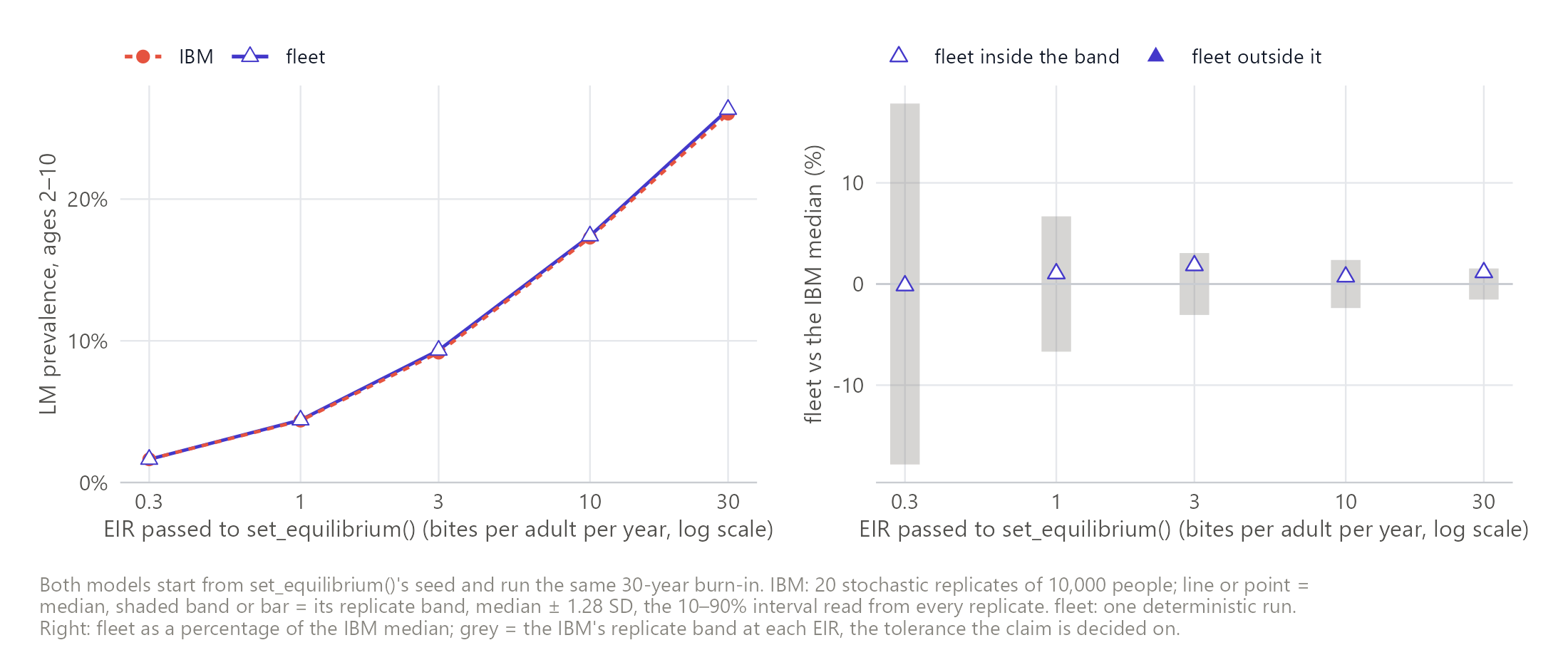
prevalence-eir-pv
pass — LM prevalence in 2-10 year olds tracks the IBM across transmission intensity.
Criterion: inside the IBM replicate band at every
EIR on the grid
Measured: inside at 5 of 5; largest departure 1.8% of
the IBM median, at EIR 3
clinical-allage-eir-pv
pass — All-age clinical incidence tracks the IBM across transmission intensity.
Criterion: inside the IBM replicate band at every
EIR on the grid
Measured: inside at 5 of 5; largest departure 1.7% of
the IBM median, at EIR 1
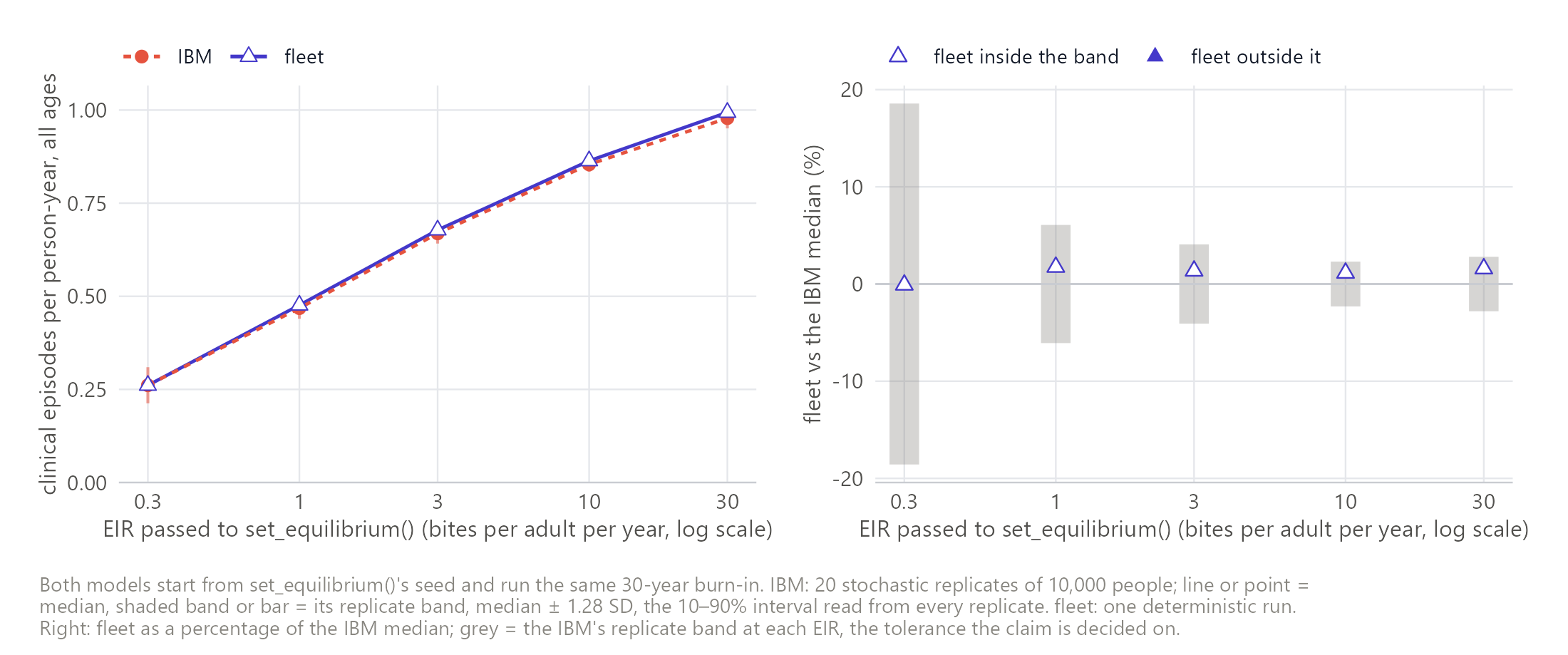
fleet sits 1.1 to 1.7% above the IBM median at every EIR from 1 up, a small offset of one sign, inside the band throughout. Part of it is the school-age excess of immunity sorting within cells, which fleet’s one immunity distribution per cell does not carry (vignette(“model”, package = “fleet”), V.7).
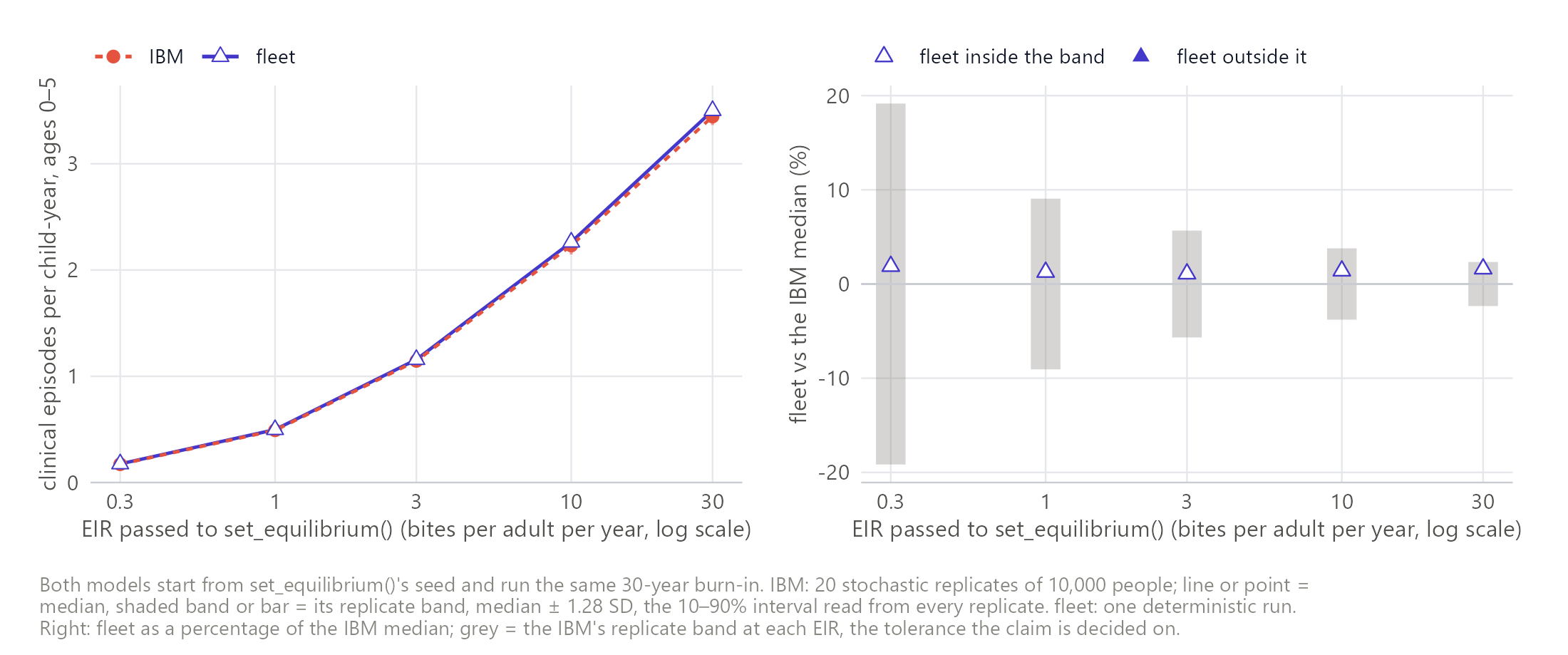
clinical-under5-eir-pv
pass — Under-5 clinical incidence tracks the IBM across transmission intensity.
Criterion: inside the IBM replicate band at every
EIR on the grid
Measured: inside at 5 of 5; largest departure 1.9% of
the IBM median, at EIR 0.3
relapse-allage-eir-pv
pass — All-age relapse incidence tracks the IBM across transmission intensity.
Criterion: inside the IBM replicate band at every
EIR on the grid
Measured: inside at 5 of 5; largest departure 3.2% of
the IBM median, at EIR 0.3, and within 1.1% from EIR 1 up
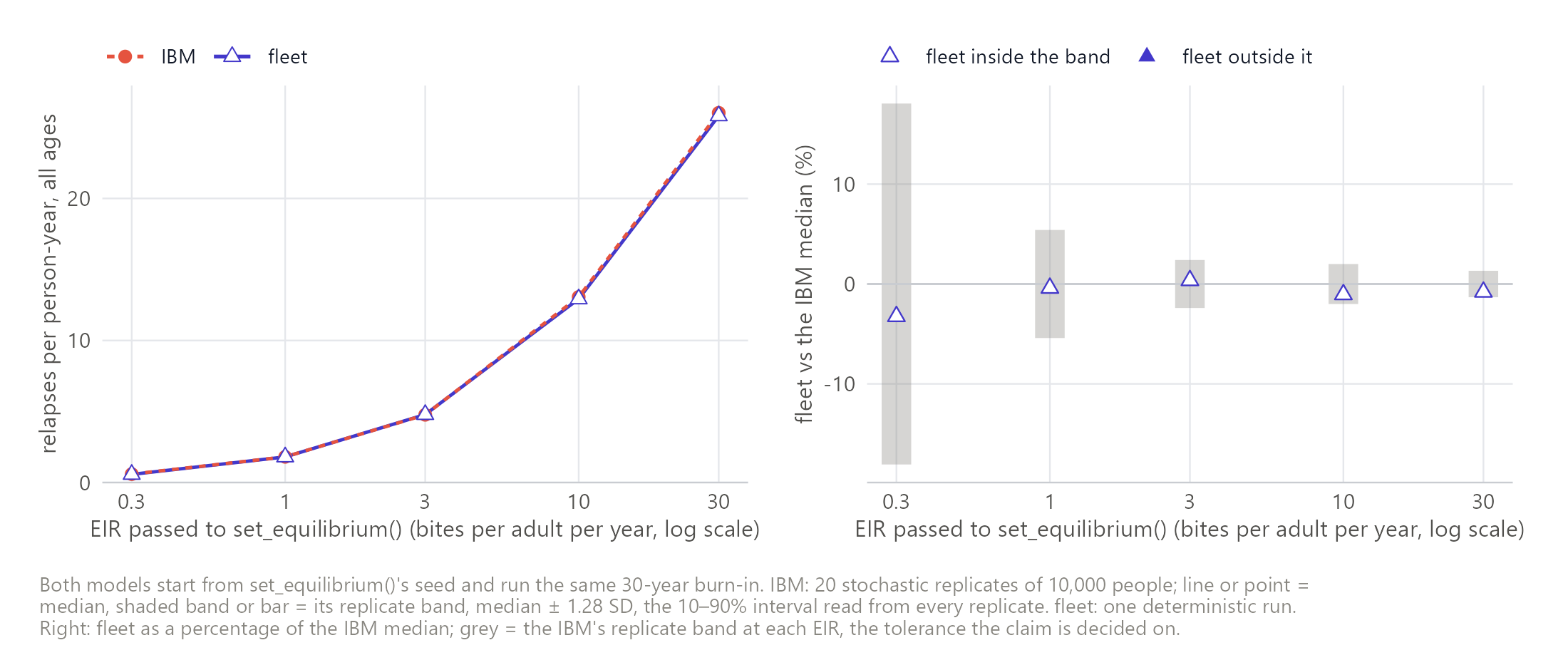
Relapses are counted over everyone and divided by the 0-100 band’s population, which in the IBM leaves out its 0.7% over 100 and in fleet holds everyone, so fleet reads about 0.7% low by construction; most of its shortfall from EIR 1 up is that. Dividing both by the whole population wants the IBM rows re-summarised, at the vivax suite’s next IBM run.
hypnozoite-carriage-eir-pv
pass — The share of people carrying hypnozoites tracks the IBM across transmission intensity.
Criterion: inside the IBM replicate band at every
EIR on the grid
Measured: inside at 5 of 5; largest departure 3.1% of
the IBM median, at EIR 0.3, and within 0.8% from EIR 1 up
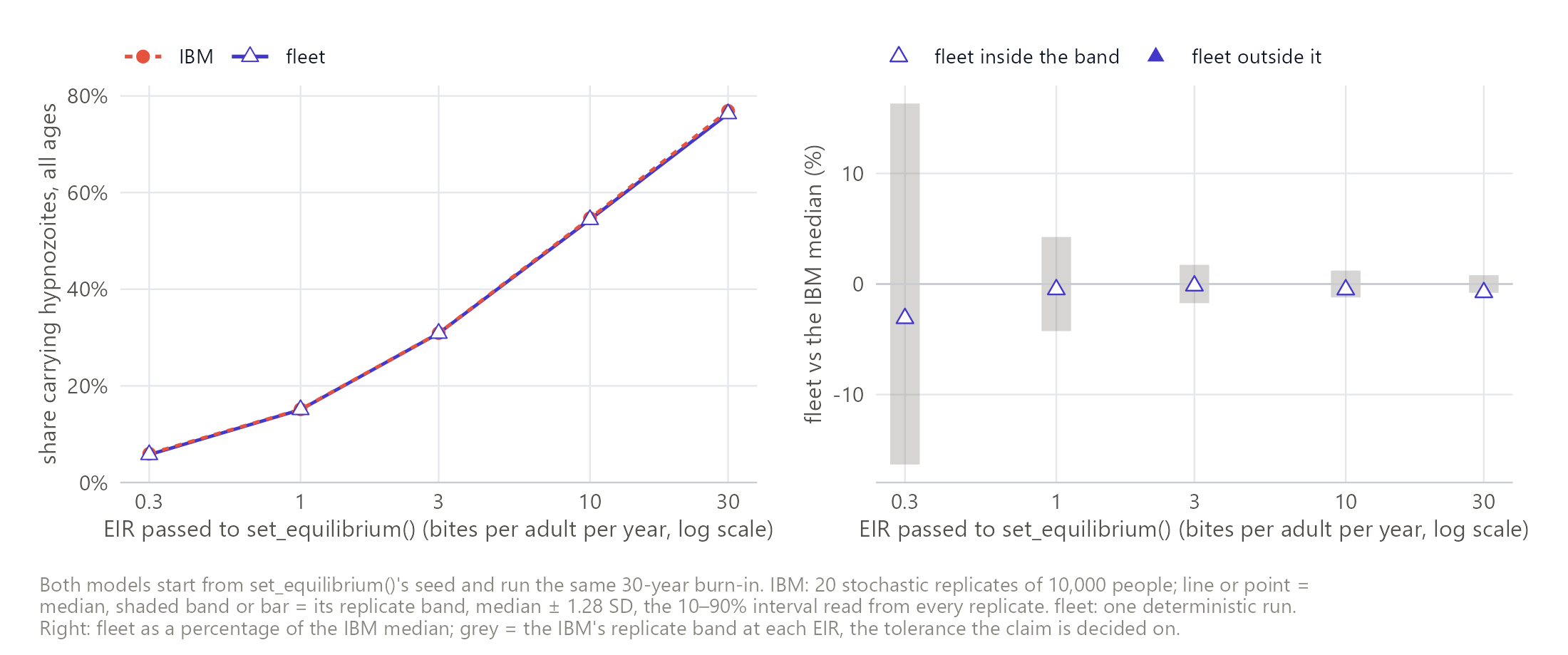
At EIR 30 fleet is 0.76% below the IBM median, against a band 0.79% wide, and nearly all of that is the denominator of relapse-allage-eir-pv: carriage is counted over everyone and divided by the 0-100 band, which in the IBM leaves out the 0.7% over 100.
age-profile-clinical-pv
pass — The age distribution of clinical incidence tracks the IBM.
Criterion: inside the IBM replicate band in every
age band carrying at least 5% of clinical episodes, at EIR 1, 3 and
10
Measured: inside at 23 of 23 tested bands across the
three EIRs, holding 90% of episodes; largest departure 1.21 replicate
SD, in the 3-5 y band at EIR 10
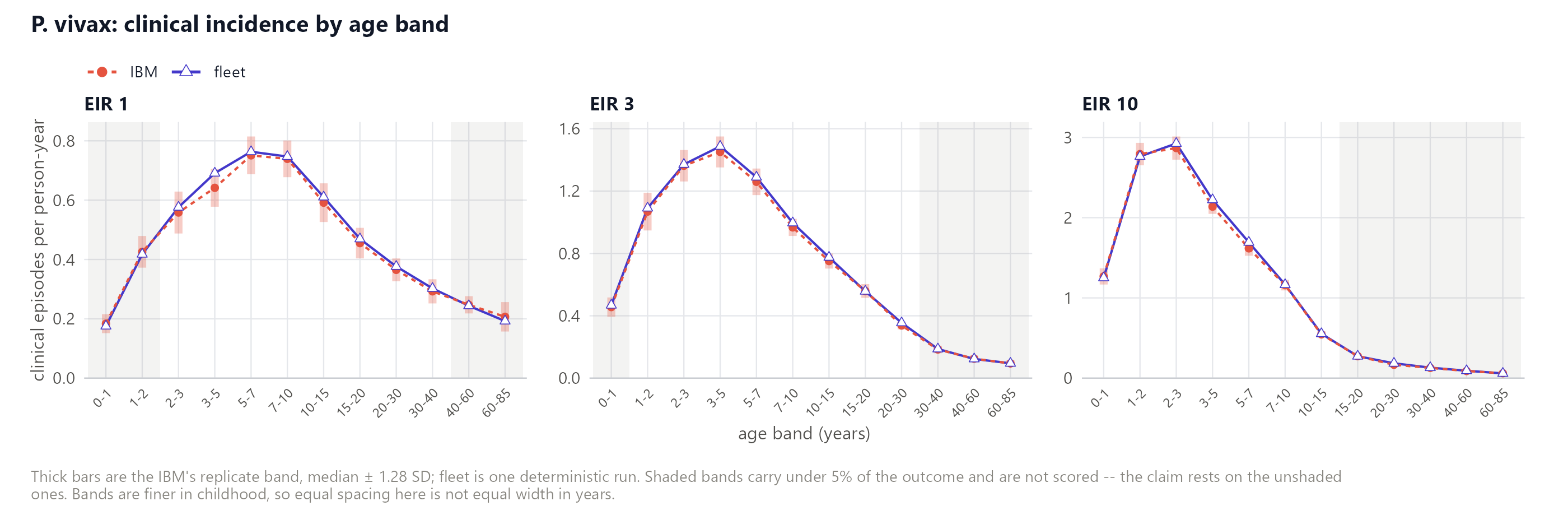
No untested band is outside either. fleet sits above the IBM median in most school-age bands, the offset of clinical-allage-eir-pv, where immunity sorting within cells leaves the mean field a little high (vignette(“model”, package = “fleet”), V.7).
intervention-impact-pv
FAIL — The modelled impact of each intervention, radical cure included, matches the IBM.
Criterion: outside the IBM replicate band in no
greater a share of cells than the best held-out IBM replicate, over
every intervention and outcome at EIR 1, 3 and 10
Measured: fleet outside in 26.7% of 60 cells, against
8.3% for the closest of the twenty IBM replicates and 24.2% for the
median one
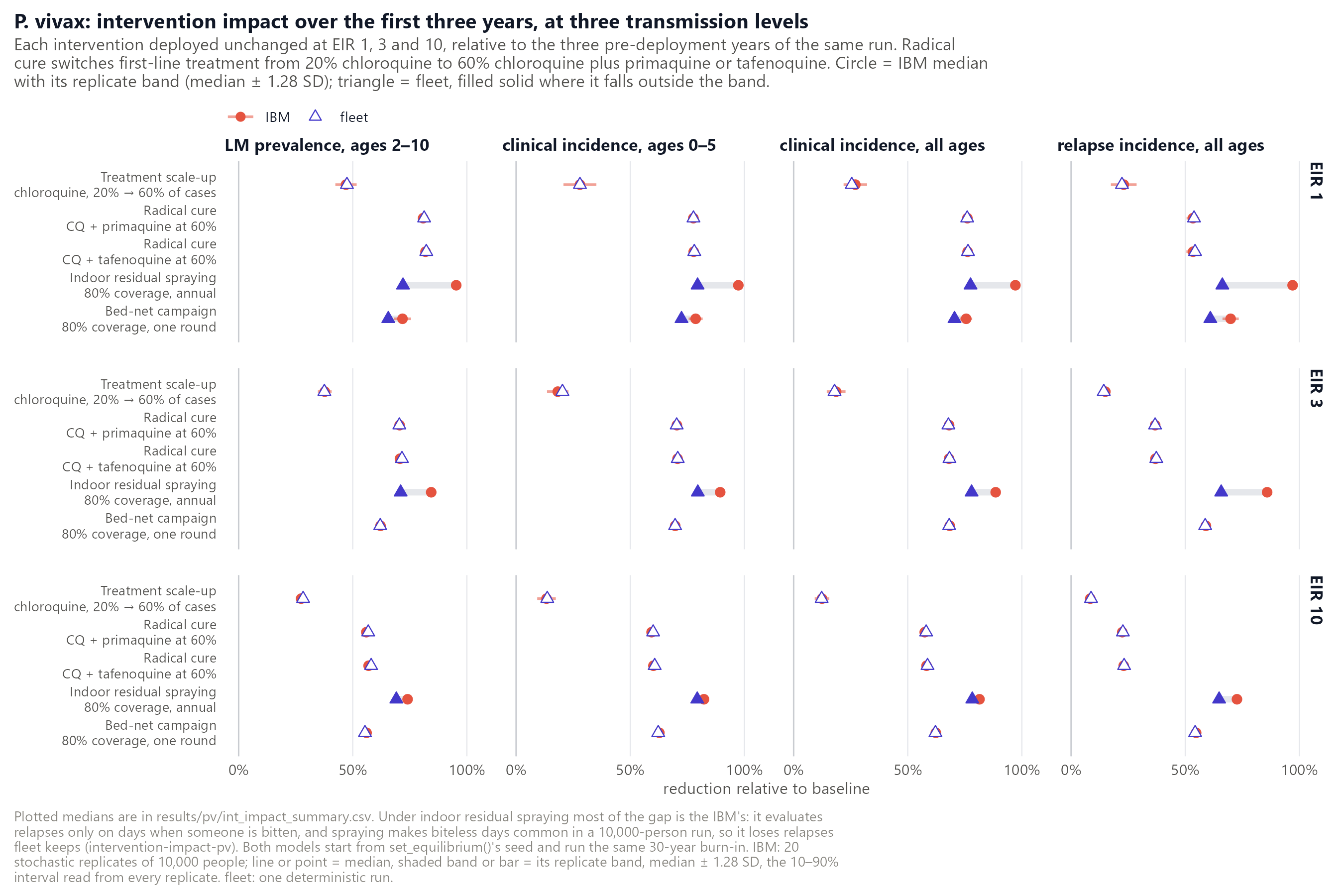
Twelve of the sixteen cells outside are indoor residual spraying, and there most of the distance is a defect in malariasimulation 3.0.0. The IBM evaluates vivax infections, relapses included, only on days when at least one person receives an infectious bite: simulate_infection() returns early on an empty bitten set, which is right for falciparum and wrong for a relapse, which needs no bite. Spraying makes days with no infectious bite across the whole 10,000-person population common, every relapse is lost on them, and the IBM eliminates vivax – every replicate at EIR 1 and 3, 13 of 20 at EIR 10 – where fleet, relapsing every day, keeps it. The other four are bed nets at EIR 1, where the IBM’s nets cut every outcome 6 to 9 points more than fleet’s: nets kill mosquitoes as well as deflecting them, and at EIR 1 that leaves days with no infectious bite too. A patched copy of malariasimulation that evaluates relapses every day brought the IBM’s reductions under spraying at EIR 3 and 10 and under nets at EIR 1 within 2.5 points of fleet’s, from up to 20 points away; that check was made against fleet’s earlier, continuous-time model and is not yet reproduced by a script here. Without the spraying scenarios fleet is outside in 8.3% of 48 cells, against 4.2% for the closest IBM replicate. Radical cure, by primaquine and by tafenoquine, agrees inside the band in every cell, as do treatment scale-up and bed nets at EIR 3 and 10.
population-age-structure-pv
pass — The population age structure matches the IBM’s.
Criterion: inside the IBM replicate band in every
age band below 60 years, on shares renormalised to the 0-60
population
Measured: inside at 11 of 11 at EIR 3; largest
departure 2.1% of the IBM median
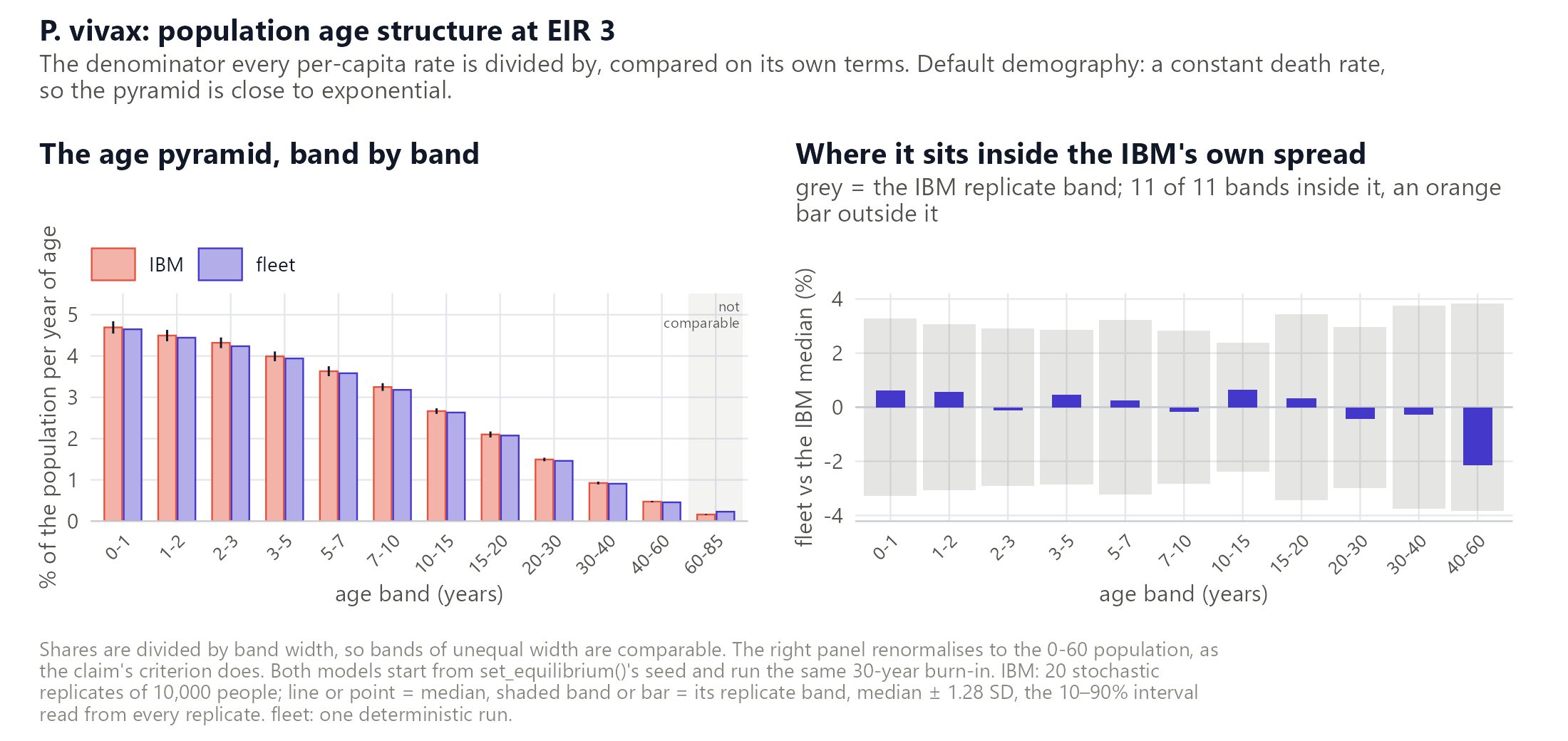
The vivax population ages and dies through compartments of its own, so its denominator is checked apart from falciparum’s, under the same 0-60 convention.
speed-pv
FAIL — fleet is fast enough to be worth using in place of the IBM.
Criterion: at least 10x faster than the IBM on the
same scenario set
Measured: 0.41x on cost per simulated year; 9.5
CPU-hours for the IBM’s 440 runs against 69 minutes for fleet’s 22
No figure: the numbers above decide this claim.
Per run, vivax fleet is the slower model: 3.9 s per simulated year against 2.1 s for a 10,000-person IBM run, both on a shared worker pool. The hypnozoite dimension and the within-cell immunity spread make it about twenty times a falciparum fleet run on the same 209-group grid, while the IBM costs about the same for either parasite. One fleet run still stands in for the twenty IBM replicates the comparison needs, and fleet’s cost does not grow with population, so the IBM arm here cost 8.3 times fleet’s; but the criterion is per run, and per run fleet does not meet it. On one laptop core a vivax run takes about 20 s per 10 simulated years, 50 s with primaquine radical cure and 85 s with tafenoquine; a 53-group grid runs about four times as fast.
seed-stability-pv
pass — An undisturbed run settles to a steady state, off the equilibrium it was seeded at, as the IBM’s does.
Criterion: PvPR(2-10) flat to under 1% over the last
five of 30 years, at EIR 0.3, 1, 3 and 10
Measured: flat to 0.27% at EIR 0.3, 0.08% at 1, 0.007%
at 3 and 0.001% at 10; settling 14%, 9%, 5% and 2% above the seeded
PvPR
No figure: the numbers above decide this claim.
The criterion is settling rather than holding the seed, because the vivax seed is neither model’s fixed point. malariaEquilibriumVivax solves each age, heterogeneity and batch cell with one immunity value, where both models build up a spread of immunity within a cell from the first day, and the vivax immunity curves are steep enough for that to move everything: over the four EIRs fleet’s clinical incidence settles 15 to 21% above the seed and its realised EIR 4 to 17% above init_EIR, PvPR overshooting first at the lowest EIRs (20.7% at EIR 0.3). The IBM moves as far: in the tier-2 runs its realised EIR ends 18%, 13% and 8% above init_EIR at EIR 0.3, 1 and 3, against fleet’s 17%, 13% and 9%. The control says why: with immunity_spread = FALSE fleet holds its seed at EIR 3 to within 1.3%. So every vivax comparison is made after a 30-year burn-in in both models – long enough at EIR 0.3, where settling takes over two decades – and a vivax run started from set_equilibrium() wants one. validations/01-seed-stability/run.R reproduces the figures.
What “tier” means
The same as for P. falciparum: what a result costs to reproduce, recorded against each claim. The costs are vivax’s own.
| tier | cost | who can reproduce it |
|---|---|---|
| 1 | a few minutes | anyone; re-runs fleet only |
| 2 | about an hour | anyone with about ten cores |